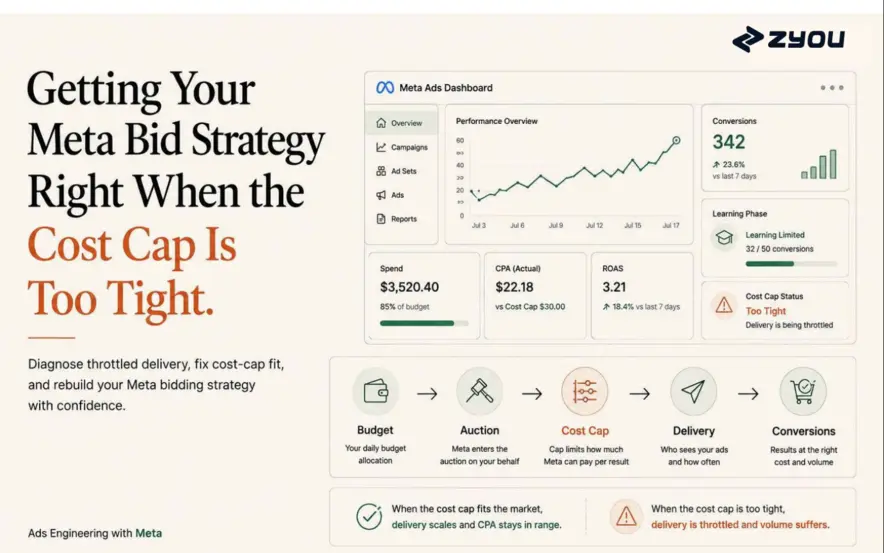
A Meta cost cap is too tight when the ad set spends well below its budget, results are scarce, and actual CPA sits under the cap. That combination means the auction is throttling delivery to protect a number it can rarely hit. The fix is to diagnose the delivery pattern first, then raise the cap toward your real target CPA or switch strategy. Below are the copy-paste prompts to do both.
Zyou connects to your ad accounts and runs prompts like these through a governed, token-optimised layer.
I run Meta accounts for a living, and a too-tight cost cap is the quietest way to lose a month. Nothing looks broken. The ad set is live, the CPA on screen is beautiful, and you feel disciplined. But spend is a trickle, volume never builds, and the ad set never exits learning. You are winning the wrong metric. This post shows how to tell a genuinely tight cap from a healthy one, and how to rebuild the whole bidding logic across an account so each ad set runs the strategy it should.
How do I know if my Meta cost cap is too tight?
Your cost cap is too tight when three things line up at once: spend runs consistently below budget, results are scarce, and actual CPA is already below the cap. If delivery is being throttled while CPA is fine, the cap is the constraint, not the market. Raise it toward your target CPA and delivery usually opens up.
The trap is reading CPA alone. A capped ad set showing a $22 CPA against a $30 cap looks like a win, but if it only spent 40% of budget to get there, Meta is skipping every auction where the projected cost would breach the cap. You are buying the cheapest sliver of demand and leaving the rest on the table. The signal is always the pairing of low delivery with a CPA that is comfortably under the cap.
What does "too tight" versus "too loose" actually look like?
Too tight means throttled delivery: spend below budget, few results, actual CPA under the cap. Too loose means the cap is not holding: the ad set spends in full but actual CPA runs above the cap for two or more consecutive days. Well-fit means near-full delivery with actual CPA landing within about 15% of the cap. Each diagnosis points to a different move.
The Cost-Cap Fit Check prompt below classifies every capped ad set into one of those three buckets from a 14-day daily series, then suggests the direction and rough size of the cap change. It applies the house rules: it needs a two-consecutive-day trend before it calls a cap "not holding," it ignores ad sets below the volume floor, and it skips anything edited in the last 48 hours, because a cap needs time to prove out.
Act as a senior Meta buyer auditing cost-cap fit. Using the connected Meta Ads data, check whether
each cost-capped or bid-capped ad set has its cap set right. Detect Ecom vs Lead-gen (house rule 4).

Pull the last [[BENCHMARK: window | default=14d]] at AD SET level, time_increment=1 (daily series):
spend, results, CPA/ROAS, CPM, CTR, frequency, plus bid strategy and cap value. Scope: [[FILTER: campaigns]].

Diagnose each capped ad set:
- CAP TOO TIGHT: spend consistently below budget AND results scarce AND actual CPA below cap
  (delivery is being throttled - room to raise the cap toward [[FILTER: target CPA]]).
- CAP TOO LOOSE: spending in full BUT actual CPA above cap for >= 2 consecutive days (house rule 1)
  (the cap is not holding - tighten it or the auction cannot meet it).
- WELL-FIT: full or near-full delivery, actual CPA within [[BENCHMARK: | default=15%]] of cap.

Apply house rules 2 and 3 (min [[BENCHMARK: min conversions | default=10]] results and
[[BENCHMARK: min spend | default=$50]]; skip edits < 48h old - a cap needs time to prove out).

Output:
- Table: Ad set | Strategy | Cap | Actual CPA/ROAS | Delivery % of budget | Diagnosis | Suggested cap.
- One line per ad set on the direction to move the cap and by roughly how much.
No change without a confirmed delivery pattern (house rule 5). Recommendation only.
How do I rebuild my whole bid strategy from first principles?
Use the Bid Logic Rebuild prompt. It pulls a 30-day daily series at campaign and ad-set level, measures how stable each ad set's efficiency is, decides which should chase volume versus hold a cost cap, calibrates every cap to the 60th percentile of achieved CPA, and hands back a per-ad-set strategy plus a safe migration order that avoids resetting learning everywhere at once.
This is the hero of the set because a single too-tight cap is usually a symptom of a bidding strategy that was never matched to the ad set in the first place. Volatile ad sets get squeezed by tight caps; stable ones can hold them comfortably. The rebuild looks at the coefficient of variation of daily CPA per ad set and assigns strategy on evidence, not habit.
Act as a Meta bidding strategist. Using the connected Meta Ads data, rebuild the bidding logic across
[[FILTER: account or campaign scope]] from first principles and recommend the right strategy per ad set.
Detect Ecom vs Lead-gen and label metrics (house rule 4).

Pull the last [[BENCHMARK: window | default=30d]] at CAMPAIGN and AD SET level, time_increment=1
(daily series): spend, results, CPA/ROAS, CPM, CTR, frequency, reach, plus current bid strategy,
cap values, budget type (ABO/CBO) and learning status.

Analysis:
1. Efficiency stability: for each ad set compute the coefficient of variation of daily CPA/ROAS.
   High variance suits highest-volume or a looser cap; low variance can hold a tight cost cap.
2. Volume vs efficiency frontier: plot results against CPA per ad set; identify which ad sets should
   optimise for volume (headroom, at target) vs cost control (thin margin, near target).
3. Cap calibration: for each capped ad set, compare actual CPA distribution to the cap; recommend a
   cap at roughly the [[BENCHMARK: percentile | default=60th]] percentile of achieved CPA.
4. Structure: recommend CBO vs ABO and consolidation where fragmentation blocks the 50-event exit.

Apply house rules 1, 2, 3 (>= 2-day trends; min [[BENCHMARK: min conversions | default=10]] and
[[BENCHMARK: min spend | default=$50]]; note entities edited < 48h ago as unsettled).

Output:
- Per ad set: Current strategy | Recommended strategy | Cap change | CBO/ABO | Rationale (one line).
- A short migration order (what to change first and why), sequenced to avoid resetting learning everywhere.
- Risks and the single metric to watch after each change. Recommendation only - no changes made.
Running these against a live account is where the plumbing matters. Zyou is governed, sandboxed, token-optimised middleware for Meta ads: it pulls your daily spend, results, and cap values into a sandbox and passes only the fields the diagnosis needs to the model, so a bidding rebuild on real money stays secure and auditable while staying cheap on tokens.
Does a tight cost cap keep my ad set stuck in learning?
Yes, often. A cost cap set too tight starves the conversion volume an ad set needs to hit the roughly 50-events-per-week exit rule. The auction throttles delivery to protect the cap, weekly results stay under 50, and the ad set sits in "learning limited" indefinitely.
That prompt finds every ad set stuck in learning, then names the specific blocker: budget too low, cap too tight, audience too narrow, event too rare, edited too often, or structure too fragmented. It ranks the three fixes that would free the most spend from learning, each tied to its confirmed cause, so you are not guessing which lever to pull first.
Which prompt do I use for which bidding question?
Start with a snapshot, escalate to a fit check, then rebuild only if the pattern is systemic. The four prompts below climb in rigor from a read-only view of every ad set's strategy to a first-principles rebuild of the whole account. Each pulls different data at a different depth. The table maps them so you run the lightest one that answers your question.
| Prompt | Rigor | Question it answers | Data pulled | Key output |
|---|---|---|---|---|
| Bid Strategy Snapshot (#53) | Basic | How is each ad set bidding and is it on target? | 14d ad set level: spend, results, CPA/ROAS, CPM, strategy, cap | Table with ON TARGET / OVER / UNDER-DELIVERING flag per ad set |
| Cost-Cap Fit Check (#54) | Intermediate | Is each cap too tight, too loose, or well-fit? | 14d ad set level, daily: spend, results, CPA/ROAS, CPM, CTR, frequency, cap | Diagnosis + suggested cap per capped ad set |
| Learning-Phase Diagnosis (#55) | Intermediate | Why is this ad set stuck in learning? | 14d ad set level, daily: results, CPA/ROAS, CPM, CTR, frequency, learning status | Blocker named per ad set + top 3 fixes by spend freed |
| Bid Logic Rebuild (#56) | Advanced | What strategy should each ad set run, and in what order do I migrate? | 30d campaign + ad set level, daily: full metric set, strategy, cap, ABO/CBO, learning status | Per-ad-set strategy, calibrated cap, migration order |
A practical order: run #53 to see the landscape, #54 the moment a cap looks suspicious, #55 if ad sets are stuck rather than just throttled, and #56 when the whole account's bidding needs a reset rather than a tweak. Do not jump to the rebuild for a single tight cap; fix that with #54.
How to read the output
The Cost-Cap Fit Check returns one row per capped ad set with a diagnosis and a suggested cap. The two columns that decide everything are Delivery % of budget and the gap between Actual CPA and the cap. Low delivery with actual CPA under the cap is the too-tight signature. Here is a realistic sample for an ecommerce account with a target CPA of $30.
| Ad set | Strategy | Cap | Actual CPA | Delivery % | Diagnosis | Suggested cap |
|---|---|---|---|---|---|---|
| Prospecting-LAL-1% | Cost cap | $22 | $19 | 41% | CAP TOO TIGHT | Raise to ~$30 |
| Broad-Advantage+ | Cost cap | $28 | $27 | 94% | WELL-FIT | Hold at $28 |
| Retargeting-ATC-14d | Cost cap | $18 | $25 | 100% | CAP TOO LOOSE | Tighten to ~$20 |
| Interest-Stack | Cost cap | $24 | $16 | 33% | CAP TOO TIGHT | Raise to ~$29 |
| Lookalike-Purch-2% | Highest vol | n/a | $31 | 98% | (uncapped) | Consider $34 cap |
Direction summary: • Prospecting-LAL-1%: raise cap ~35%. Delivery throttled at 41% while CPA runs $11 under cap. • Interest-Stack: raise cap ~20%. Same pattern, spending only a third of budget. • Retargeting-ATC-14d: cap not holding (CPA $7 over cap, 2+ days). Tighten or accept higher CPA.
Read it like this. Prospecting-LAL-1% and Interest-Stack are the too-tight offenders: both spend a third to 40% of budget while their actual CPA sits well under the cap, so the cap is the throttle. Raising each toward the $30 target should open delivery without wrecking efficiency. Broad-Advantage+ is exactly where you want to be, full delivery at a CPA hugging the cap, so leave it. Retargeting-ATC-14d is the opposite problem, a cap the auction cannot meet, so either tighten it or accept the higher real cost. The uncapped highest-volume ad set is a candidate for its first cap now that you know its natural CPA.
FAQ
These four are the bidding-strategy slice of a much larger set. Enter your email and we will send the complete 100+ Meta ads prompt library — each copy-paste ready with exact data fields, thresholds, and output format.